The dances
Samba, belly dance and burlesque: where the acts on the Mango’s bill come from
Three performance traditions named on the booking page, traced through Wikipedia: Brazil’s samba, the Egyptian-rooted belly dance and the American burlesque revue.
Save my table ↗Quick answer
The booking page lists Brazilian samba, belly dancers and a burlesque show among the acts, and each comes from a different corner of the world. Samba took shape among Black Brazilian communities in Bahia and Rio de Janeiro around the turn of the twentieth century. Belly dance is a Middle Eastern dance that originated in Egypt. Burlesque, in its American stage sense, is a revue style that flourished from the 1860s into the 1940s. A cabaret mixes them for effect; knowing the roots makes the mix easier to follow.
Three traditions on the bill
| Where it comes from | What Wikipedia stresses | |
|---|---|---|
| Samba | Afro-Brazilian communities of Bahia and Rio de Janeiro | A symbol of Brazilian national identity, tied to Carnival and samba schools |
| Belly dance | Egypt, with regional forms across the Middle East | Movements of the hips and torso; Egyptian cinema made its styles the best known |
| Burlesque | Literary parody that became a variety stage format | In the United States a show format of comic sketches and striptease, that flourished from the 1860s into the 1940s |
Samba: from Bahia to Carnival
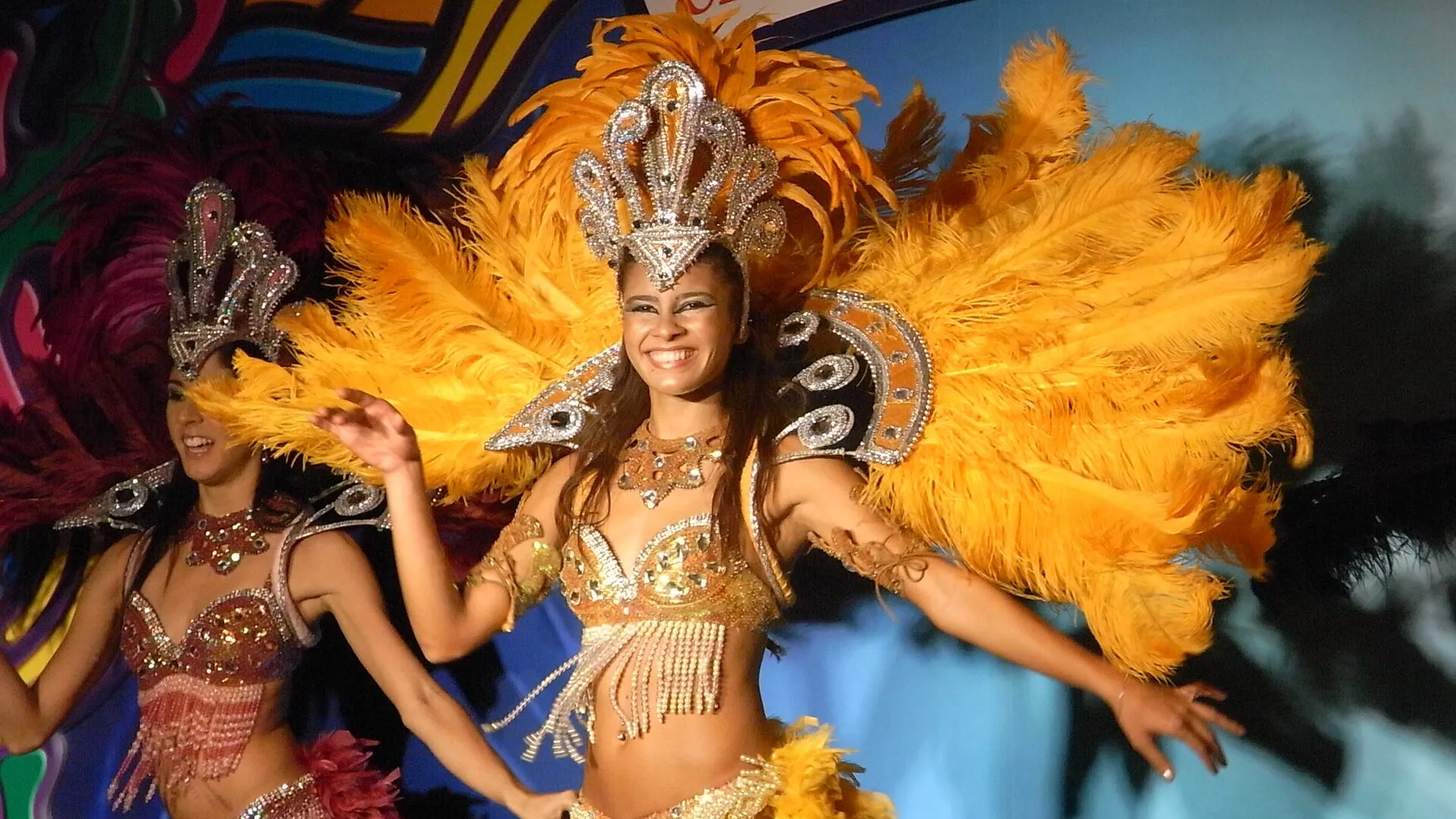
Wikipedia describes samba as a broad term for many of the rhythms that make up Brazil's best-known music genres, originating in the Afro-Brazilian neighbourhoods of Bahia around the turn of the twentieth century. The word was first used for a popular dance before it came to mean a circle dance, a dance style and a music genre. The song 'Pelo Telefone', released in 1917 as a carnival samba, is treated as the landmark that started the genre's life as a recorded form, and the modern urban samba of Rio took its structure in the late 1920s in the Estácio neighbourhood. Samba was once criminalised; gatherings were broken up and instruments destroyed, yet it became a highlight of Carnival and one of the symbols of Brazilian identity. The feathered headdresses that dancers wear in cabaret shows echo the costumes of Carnival parades.
Samba schools and the percussion band
Wikipedia credits the Estácio composer Ismael Silva with the phrase 'samba school', and it notes that the claim to be the first school is contested between Portela and Mangueira. The group Deixa Falar was a pioneer in spreading the term and in using the percussion unit later known as the bateria, which includes the surdo, tamborim and cuica. The surdo marks the cadence with its deep, syncopated beat, a break with the lighter patterns that came before. In a cabaret you will not see a full school, but a live band with drums will give you the same feeling of rhythm driving the dancers. The booking page does not say which samba numbers are performed, so treat the tradition as background and not as a programme.
Belly dance: hips, torso and an exonym
Wikipedia defines belly dance as a Middle Eastern dance that originated in Egypt and features movements of the hips and torso. It points out that 'belly dance' is a Western-coined exonym, a translation of the French danse du ventre, which first appears in 1864 in a review of Jean-Léon Gérôme's painting Dance of the Almeh; the first known English use is from 1883. The dance takes many forms by country and region, in costume and style, and the Egyptian styles are the most widely recognised because of Egyptian cinema. Unlike many Western forms, it focuses on isolating the muscles of the torso, with percussive, fluid and shimmering movements. In a Latin cabaret it adds a second rhythm vocabulary to the evening, which is why the listing counts it alongside the Brazilian and Cuban numbers.
Burlesque: a word with two lives
Wikipedia traces burlesque to the Italian word burlesco, from burla, a joke, and says the term first meant a literary or dramatic work that makes people laugh by caricaturing serious works. It adds a later American use, a revue style that flourished between the 1860s and the 1940s in cabarets, clubs and theatres, featuring bawdy comedy and female striptease, with a resurgence of interest since the 1990s. The booking page names a burlesque show but does not describe it, so this guide cannot say what yours will contain. What the history does tell you is that burlesque is a theatrical, tongue-in-cheek tradition, which is a reason to check the age line and plan the night as one for adults.
How the mix works on the night
A cabaret borrows from all three on purpose. Samba and conga bring percussion and movement, belly dance brings a different sound and gesture, and burlesque brings comedy and showmanship. The result suits a room that wants variety, and it explains why reviewers talk about the dancers and singers changing continuously. None of the three traditions needs prior knowledge to enjoy, and none is a lecture; the best preparation is to arrive with an open mind and a table of people ready to clap along.
Frequently asked questions
Is the samba on the bill a Carnival show?
The page lists Brazilian samba among the acts but does not describe the staging, so it is safest to expect a stage number, not a parade.
Is belly dance part of the show?
Yes, the booking page names belly dancers as one of the acts.
Is the burlesque act suitable for children?
Children under 10 are ruled out, and burlesque is a grown-up genre, so plan it as an adult evening.
Will I see a specific samba school?
No. A samba school is a Carnival organisation in Brazil; a cabaret show borrows its rhythms and costumes.
Sources